
Perfect One Day in Everglades National Park Itinerary for First-Timers


Looking to make the most of your day trip to a swampy stretch of land filled with gators and airboats?
Just outside Miami, this stretch of South Florida is a completely different kind of wild. Instead of mountains, airboats hum in the distance, and boardwalks twist through dense mangroves.
With slow-moving waters and the sound of distant wildlife echoing through the trees, there’s no single landmark that sums up the Everglades. For first-time visitors, it helps to have a clear route through freshwater sloughs and coastal trails.
This one day in Everglades National Park itinerary covers the best of the park with some other planning details to help you plan.

Sample One Day in Everglades Itinerary
Everglades National Park is divided into two main areas. The northern section, known as Shark Valley, is about an hour west of the city and features a paved 15-mile loop ideal for biking or taking a tram tour, plus a tall observation tower of the wetlands. Wildlife sightings here are common, especially in the morning when animals are most active.
Because of the distance between the two areas (about 1.5 hours by car), it’s best to plan your route carefully. For a day trip coming from Miami, the most efficient plan is to start at Shark Valley early in the morning and then head south to explore the Homestead side.
Here’s a single, streamlined day trip itinerary with everything you need in one place.

Want a guided experience instead? Do it all with this highly-rated tour that includes a boat ride, kayaks and a walking excursion!
- Head to Shark Valley and take a guided tram tour, rent a bike, or take an airboat through sawgrass marshes.
- Climb the Shark Valley Observation Tower for panoramic views across the Everglades landscape.
- Drive south to the Ernest Coe Visitor Center to get orientated with this area.
- Drive to Royal Palm to hike the Anhinga Trail, then the Gumbo Limbo Trail.
- Stop at Mahogany Hammock Trail to walk the short boardwalk loop.
- Optional: Kayak the Nine Mile Pond Canoe Trail through a marked paddling route past mangroves and open water.
- Drive to the Flamingo Visitor Center, the southernmost point in the park, to spot manatees and crocodiles.
- Take a boat tour to Florida Bay or a backcountry boat excursion to explore the park’s mangrove forests and coastal waters. Reserve here.
- Catch the sunset at Paurotis Pond before returning to Ernest Coe Visitor Center.
Recommended Places to Stay Near Everglades

Quick Facts to Visiting Everglades
Everglades National Park is the largest subtropical wilderness in the United States, spanning 1.5 million acres of wetlands, mangroves, and sawgrass marshes. Designated a World Heritage Site, International Biosphere Reserve, and Wetland of International Importance, it’s one of the only places on Earth where alligators and crocodiles coexist.
The park is also home to over 360 bird species and serves as a vital stop for migratory birds each winter. With no roads cutting through the heart of the park, visitors must explore by airboat, kayak, or on foot.
| Facts | Details |
|---|---|
| Entrance Fee | $30 per vehicle (valid for 7 days), $15 per person on foot or bike, $55 annual pass |
| Operating Hours | Open 24/7; Visitor centers open 8:00 a.m. – 5:00 p.m. |
| Visitor Centers | Ernest Coe Visitor Center, Flamingo Visitor Center, Shark Valley Visitor Center, Gulf Coast Visitor Center |
| Park Entrances | Main Entrance (Homestead), Shark Valley Entrance, Gulf Coast Entrance |
| Number of Campgrounds | 2 developed campgrounds (Long Pine Key, Flamingo); multiple backcountry sites |
| Number of Hotels | Flamingo Lodge; otherwise Homestead, Florida City, and Everglades City |
| Best Time to Visit | December to April for dry season |
| Nearest Cities | Homestead (10 miles), Miami (40 miles), Everglades City (50 miles) Use DiscoverCars to find rental car deals or rent an RV or campervan with Outdoorsy. |
| Nearest Airports | Miami International Airport (40 miles), Fort Lauderdale-Hollywood International Airport (75 miles), Naples Airport (70 miles) Use Expedia to find the best flight prices. |
Know Before You Go!
- Shark Valley Tram Reservations: Booking ahead is recommended for the popular tram tour, especially in peak season.
- Airboat Tours: Only authorized concessionaires operate airboat tours within the park; book in advance during high season or join this tour!
- Seasonal Road Closures: Check for road closures in the wet season (May to October) due to flooding.
- Mosquito Season: Be prepared for heavy mosquito activity in summer and early fall; bring repellent.
What to Do in Everglades in One Day

Choose Your Adventure at Shark Valley
Most likely, you’re coming from Miami, so drive west to Shark Valley along the Tamiami Trail.
At Shark Valley, you can board a two-hour guided tram tour or take an airboat tour along the shallow waters of the park’s famous sawgrass prairies.
Along the way, guides point out wildlife like alligators, turtles, and wading birds. This is especially great in the morning when the wildlife is at its most active.
Tram tours start daily at 9:30 am, 11 am, 2 pm, and 4 pm. You can also rent a bicycle for a self-guided trip. Reserve here.
Find an official NPS-permitted airboat tour here.
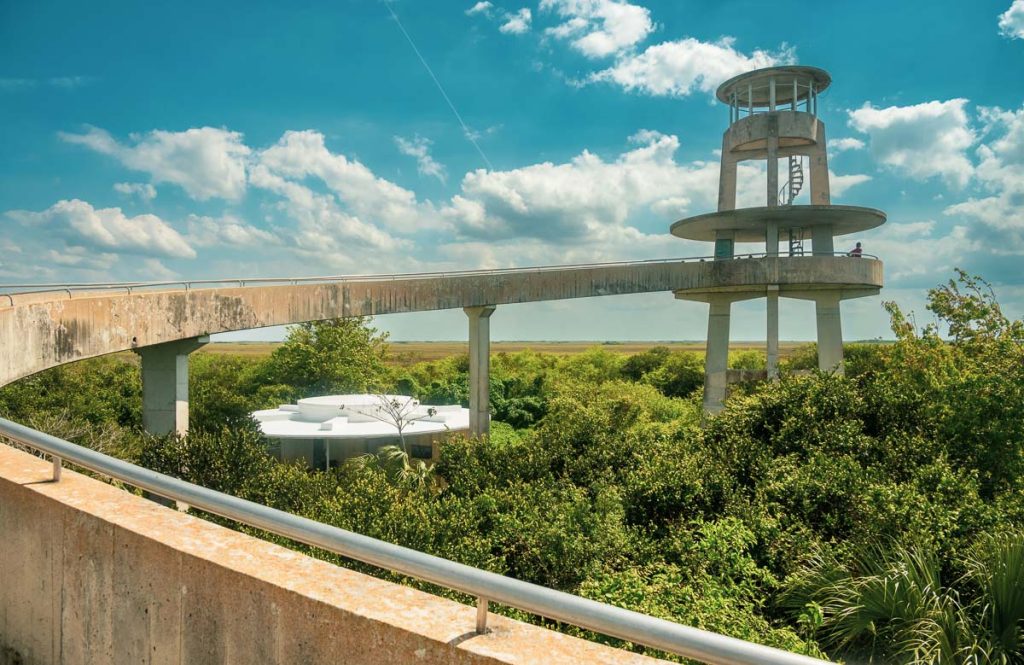
Climb the Shark Valley Observation Tower
Along the paved path, take time to climb the Shark Valley Observation Tower, a 70 foot-tall structure with 360-degree views over the Everglades. The paved path to the tower is about 0.5 miles each way and is wheelchair accessible.
From the top, you can see for miles in every direction and catch sight of large birds like ospreys and vultures.
Drive South to the Ernest Coe Visitor Center
Make the 45 minute drive south to the Ernest Coe Visitor Center, the primary gateway to Everglades National Park. This is the best place to pick up maps, collect your national park stamp, and talk to rangers about any boat trips.
Once you’ve stocked up on maps and filled your water bottles, head out on the Main Park Road toward Royal Palm, your first major stop.
Royal Palm
A quick 15-minute drive from the visitor center brings you to the Royal Palm area, home to two of the park’s most accessible and wildlife-rich trails: the Anhinga Trail and the Gumbo Limbo Trail.
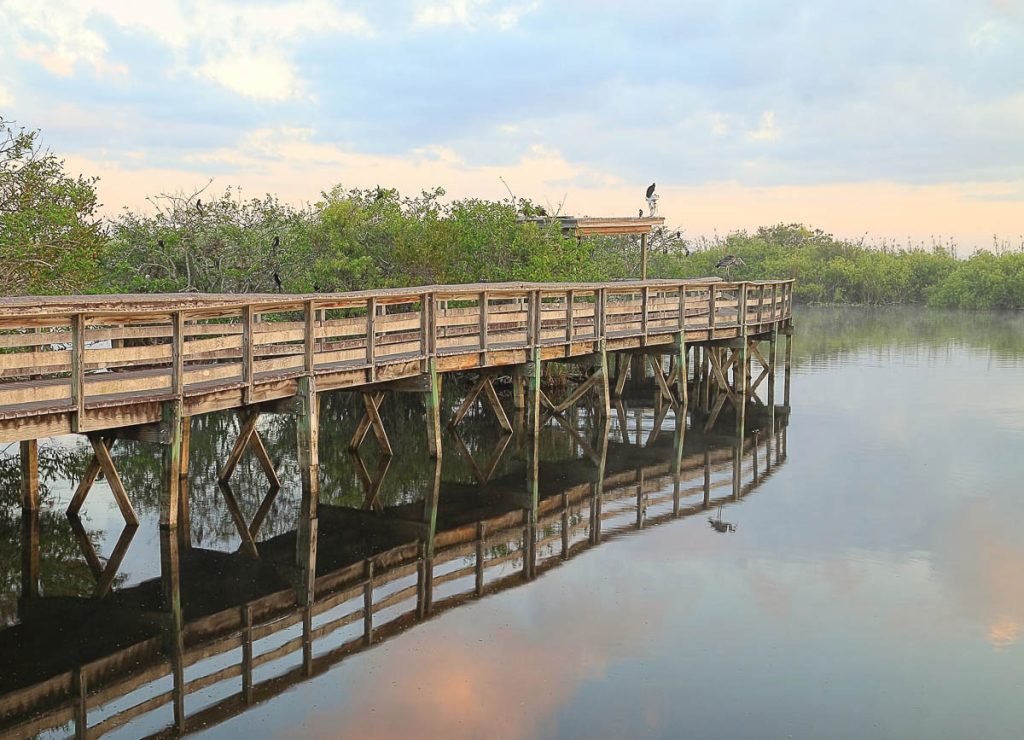
Anhinga Trail
- Distance: 0.8 miles roundtrip (boardwalk)
- Difficulty: Easy
The Anhinga Trail is one of the best spots in the park for wildlife viewing, and it’s an ideal first hike of the day. The boardwalk winds through a freshwater sawgrass marsh, with open views over the slough and multiple observation platforms.
Look for alligators sunning themselves along the banks, as well as herons, egrets, and anhingas drying their wings on tree branches. The best time to walk the trail is early in the morning when the animals are more active.
The boardwalk makes a short loop, bringing you back to the starting point where you can pick up the next trail.

Gumbo Limbo Trail
- Distance: 0.4 miles roundtrip
- Difficulty: Easy
Just steps away from the Anhinga Trail, the Gumbo Limbo Trail is a completely different experience. This loop takes you through a dense hardwood hammock, where the temperature drops and the air feels cooler.
The path is lined with gumbo limbo trees, which are known for their smooth, peeling bark and distinctive red trunks. It’s also a good spot to spot lizards and tree snails.
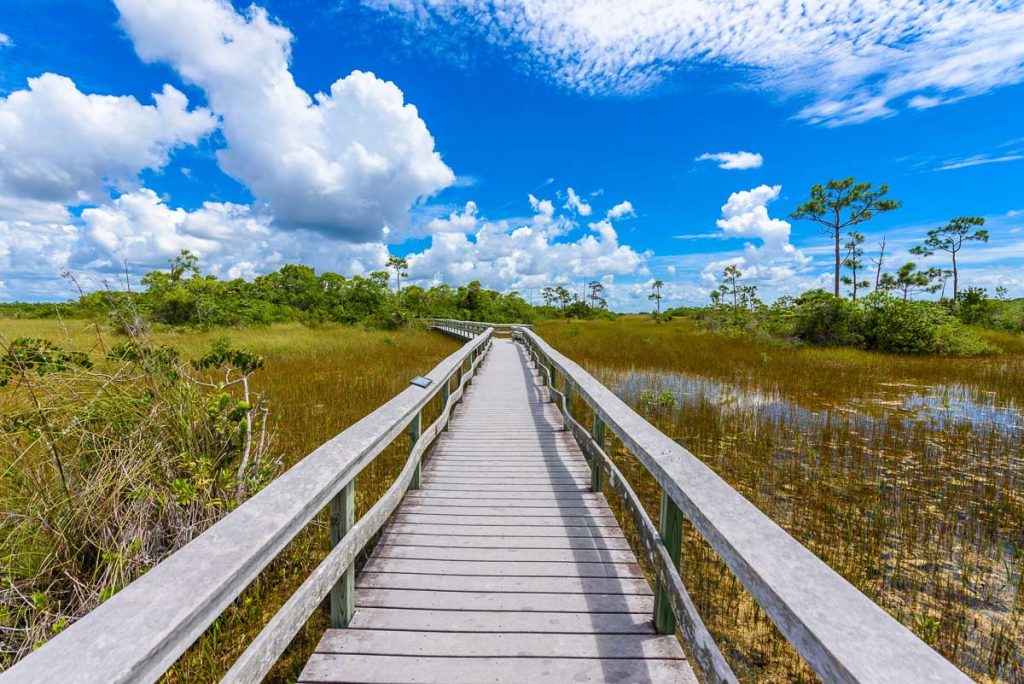
Stop at Mahogany Hammock Trail
- Distance: 0.5 miles roundtrip
- Difficulty: Easy; flat boardwalk
Stop at the Mahogany Hammock Trail, a short loop that passes through one of the park’s oldest and densest hardwood hammocks. The boardwalk winds through a canopy of giant mahogany trees, some of the largest in the United States.

Optional: Kayak the Nine Mile Pond Canoe Trail
- Distance: 5 miles roundtrip
- Difficulty: Moderate
Back in the car, head south to the Nine Mile Pond Canoe Trail, a marked paddling route that weaves through mangrove tunnels, open ponds, and sawgrass flats.
If you brought your own kayak or rented one, launch from the small boat ramp. This area is known for its birdlife and alligator sightings, and the maze-like waterways make it feel remote and wild. Allow 2–3 hours for the full loop, depending on water levels and paddling speed.
Visit Flamingo Visitor Center for a Boat Tour
Continue south to the Flamingo Visitor Center, a sprawling area where the Everglades meets Florida Bay. The visitor center has exhibits and a small marina where you can spot manatees and American crocodiles, two species uncommon in other parts of the park.
Walk along the docks and check the marina for tarpon and nurse sharks, both of which are frequently spotted in the brackish water. This is also the departure point for the 90 minute boat tours into Florida Bay or the Backcountry Boat Tour.
Find availability and departure times here between November and April only.

Catch Sunset at Paurotis Pond
The final stop of the day is Paurotis Pond, just a few miles back up the Main Park Road from Flamingo. This pond is known as a nesting site for wading birds, including great egrets and roseate spoonbills, especially in the dry season.
Where to Stay
Staying near Everglades National Park, Homestead, and Florida City are the most convenient base locations. Both are just minutes from the park’s main entrance, with a range of hotels, motels, and campgrounds to fit various budgets. Otherwise, many make a longer day trip from Miami to see both areas of the park.
Best Hotels near Everglades
📍Florida City, FL
📍Everglades City, FL

Places to Visit with More Time
If you have more than a day in the Everglades, explore these lesser-known spots:
- Bear Lake Trail – A 2.5-mile out-and-back hike through dense mangroves that leads to a secluded lake known for birdwatching.
- Hell’s Bay Canoe Trail – A 5-mile paddle through a maze of mangroves, ideal for experienced kayakers seeking remote waterways.
- Pa-Hay-Okee Overlook – A raised boardwalk with sweeping views over the vast sawgrass prairie.
- Eco Pond – Short walk to a brackish pond that attracts wading birds and alligators, especially during the dry season.
- Shark Valley Night Walks – Ranger-led evening walks to spot nocturnal wildlife and hear the distinctive calls of owls and frogs.
- West Lake Trail – A short boardwalk through red mangroves with interpretive signs about the Everglades’ coastal ecosystems.
Day Trips Near Everglades (Within 3 Hours)
- Miami, FL (1 hr) – Explore the neighborhoods of Little Havana and Wynwood, then relax at South Beach.
- Key Largo, FL (1.5 hrs) – Snorkel at John Pennekamp Coral Reef State Park, known for its underwater coral reefs.
- Big Cypress National Preserve (30 min) – Drive the scenic Loop Road to spot alligators and birds or hike the Kirby Storter Trail.
- Naples, FL (1.5 hrs) – Visit the historic downtown, shop on Fifth Avenue South, or catch a sunset at Naples Pier.
- Marco Island, FL (1.5 hrs) – Take a boat tour through the Ten Thousand Islands, a maze of mangroves and tidal flats.
- Biscayne National Park (1 hr) – Kayak the mangrove coastline or take a guided boat tour to the offshore reefs.
- Coral Gables, FL (1 hr) – Visit the historic Venetian Pool, Fairchild Tropical Botanic Garden, or the Biltmore Hotel.
- Key Biscayne, FL (1.5 hrs) – Walk the lighthouse at Bill Baggs Cape Florida State Park and swim at the beach.
- Fort Lauderdale, FL (2 hrs) – Take a canal tour by water taxi or stroll the Riverwalk for dining and shopping.

Is 1 Day Enough for Everglades?
A single day in Everglades National Park can give you a solid overview of its diverse ecosystems, but be rushed. Start at Shark Valley to take the tram tour and climb the observation tower. Then, drive from Royal Palm to hike before ending the day with a stop at Flamingo Marina, where manatees and crocodiles are often seen near the docks.
If you have more time, consider staying overnight to explore the more remote sections of the park. With two days, you could paddle the Nine Mile Pond Canoe Trail, hike the Bear Lake Trail, or camp at Flamingo Campground to experience the Everglades at night. With three days, you’d have time to tackle the longer Coastal Prairie Trail or kayak through the mangrove tunnels of Hell’s Bay.
Best Time to Visit Everglades National Park
The ideal time to visit Everglades National Park is during the dry season, from December to April, when cooler temperatures and lower humidity make hiking and paddling more comfortable. Wildlife is also more concentrated around water sources, and we all love it when there are fewer mosquitos.
From May to November, the wet season brings intense heat, high humidity, and daily afternoon thunderstorms. While the park is lush and green, heavy rains can flood trails and close backcountry areas. Mosquitos are also intense during this period, but it’s a prime time to see baby alligators and nesting birds.
How to Get There
Everglades National Park is accessible by car through three main entrances: the Main Entrance at Homestead, the Shark Valley Entrance off Tamiami Trail, and the Gulf Coast Entrance in Everglades City. The closest major airports are Miami International Airport (MIA), Fort Lauderdale-Hollywood International Airport (FLL), and Naples Airport (APF).
For visitors flying in, renting a car is essential, as there is no public transportation within the park. Use DiscoverCars to find rental car deals or rent an RV or campervan with Outdoorsy.
Catherine, a seasoned travel writer, has lived in 4 different states and explored 36 states and 28 national parks. After spending two years embracing van life, she's now dedicated to sharing her vast knowledge of day trips across America. Catherine's other works has been referenced in major publications like MSN, Self, and TripSavvy.
| MY FAVORITE TRAVEL RESOURCES |
✈️ Find amazing guided tours and experiences with Viator to maximize your time! 🏘️ Plan ahead and secure your accommodation with Booking.com in advance. 🧾 Rent a car with Discovercars in advance and get the best prices for your day trip adventures. |