
12 Famous Lighthouses in the USA That Make the Coastline Even More Beautiful
 ByCat Xu

America’s lighthouse history is packed with shipwrecks, wild engineering fixes, presidential signatures and very steep staircases. Some towers moved, one made its way into deep space in photographic form and several survived wars or storms that tried very hard to get rid of them. These 12 famous lighthouses in the USA stand out because their histories are strange and their settings are hard to mistake.
Portland Head Light, Maine

Maine had Portland Head Light before Maine was even a state. The light first burned on January 10, 1791 after Congress supplied money to finish the tower, making it the oldest lighthouse in Maine. On Christmas Eve in 1886, the bark Annie C. Maguire hit the ledge below the tower and the keeper’s family helped get everyone ashore. Today the former keeper’s quarters hold a museum inside Fort Williams Park, where the rocky shoreline does most of the work for photographers.
Cape Hatteras Lighthouse, North Carolina

Cape Hatteras Lighthouse once took a 2,900 foot road trip without leaving the Outer Banks. In 1999 crews moved the 4,830 ton brick tower inland over 23 days because erosion had brought the Atlantic dangerously close. The current lighthouse was lit in 1870 and rises 198.49 feet, making it the tallest brick lighthouse in the United States. Climbing remains closed in 2026 during restoration work, but its black and white spiral is still one of the coast’s easiest landmarks to pick out.
Nubble Lighthouse, Maine

One of Maine’s tiniest lighthouse islands ended up representing Earth in deep space. A photograph of Nubble Lighthouse was included among the images carried aboard the Voyager spacecraft on the Golden Record launched in 1977. The tower has marked Nubble Island since July 1, 1879 and its light can be seen for 13 nautical miles. Visitors view it from Sohier Park on the mainland, which means this famous space traveler cannot actually be toured up close.
Bass Harbor Head Light, Maine
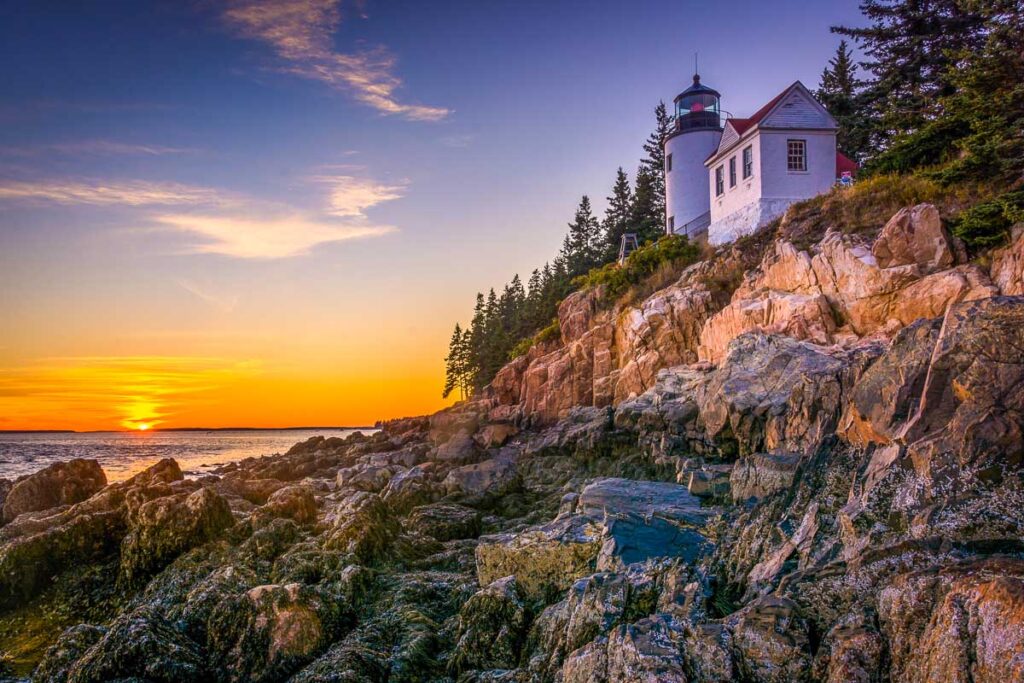
Acadia National Park has one lighthouse visitors can easily reach by car, and Bass Harbor Head Light landed on a very good piece of coastline. The station was constructed in 1858 to mark the entrance to Bass Harbor and Blue Hill Bay while its tower measures just 37 feet tall. A fourth order Fresnel lens remains inside and the red light has a range of about 13 miles. For the shoreline angle seen in so many photos, the cliff viewpoint requires 37 wooden steps followed by 27 stone steps.
Split Rock Lighthouse, Minnesota

Split Rock Lighthouse exists because Lake Superior had an especially bad day on November 28, 1905. A single storm damaged 29 ships and two steel freighters foundered along the North Shore, helping push the case for a new lighthouse. Congress appropriated $75,000 and the station was completed in 1910 on a cliff about 130 feet above the lake. At the top of a 32 step spiral staircase, the original French Fresnel lens still turns with its original clockwork mechanism.
Heceta Head Lighthouse, Oregon

Heceta Head Lighthouse is only 56 feet tall, yet its beam starts more than 200 feet above the Pacific. First illuminated in 1894, its automated beacon can be seen about 21 miles from land and is rated as the strongest light on the Oregon coast. A half mile trail climbs from the parking area past the old lightkeeper’s house before reaching the tower. That house now operates as a bed and breakfast, so an overnight stay can put you next door to a working beacon.
Montauk Point Lighthouse, New York
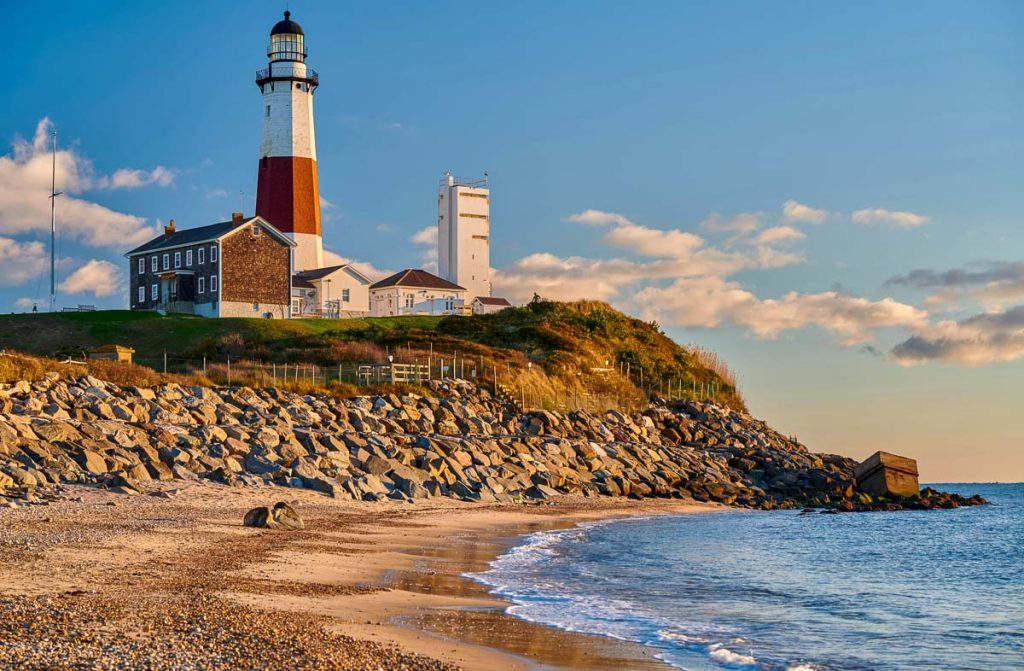
George Washington approved Montauk Point Lighthouse before the White House was finished. The Second Congress authorized it in 1792 under Washington and construction was completed on November 5, 1796. It became the first lighthouse in New York and is now the fourth oldest active lighthouse in the country, with 137 iron steps leading up its 110 foot tower. It received National Historic Landmark status in 2012 and its light flashes every five seconds with a range of 19 nautical miles.
Pigeon Point Lighthouse, California

Pigeon Point Lighthouse got its name from a shipwreck, which is a fairly dark origin story for a safety landmark. The clipper ship Carrier Pigeon ran aground nearby in 1853 and the lighthouse first lit the coast on November 15, 1872. California State Parks identifies the 115 foot tower as the tallest operating lighthouse on the West Coast. Its original Fresnel lens contains 1,008 prisms, stands 16 feet tall and weighs about 2,000 pounds, and travelers can now see it inside the fog signal building.
Cape Lookout Lighthouse, North Carolina

Cape Lookout’s diamonds are not decoration, they are a giant daytime identification system for sailors. The 163 foot lighthouse was first lit in 1859 and received its black and white diamond pattern in 1873 after nearby towers began making coastal identification tricky. The black diamonds face north and south while the white diamonds face east and west, so the tower actually appears different depending on the direction of approach. The light station sits on a barrier island reached only by boat, and the lighthouse itself is undergoing stabilization work following structural concerns discovered in 2021.
Tybee Island Lighthouse, Georgia

Tybee Island has been rebuilding versions of its lighthouse since 1736, giving this Georgia landmark a seriously complicated family tree. Its surviving foundation dates to 1773, while Confederate troops destroyed the wooden stairs and top 40 feet of the tower during the Civil War to keep Union forces from using it. The damaged lighthouse was rebuilt after the war and still carries a first order Fresnel lens. Today the tower stands 145 feet tall with 178 steps, earning its billing as Georgia’s oldest and tallest lighthouse.
Cape Disappointment Lighthouse, Washington

The ship carrying materials to build Cape Disappointment Lighthouse wrecked before the lighthouse could save anybody. The Oriole ran aground while entering the Columbia River in 1853 and its cargo of construction materials was lost, delaying an already difficult project. The lighthouse finally began operating on October 15, 1856 and its 53 foot tower is the oldest lighthouse in the Pacific Northwest. Travelers can view the exterior inside Cape Disappointment State Park, which also contains North Head Lighthouse a short distance up the coast.
West Quoddy Head Lighthouse, Maine

West Quoddy Head looks almost too cheerful for a station built to keep ships away from some very nasty rocks. President Thomas Jefferson commissioned the original lighthouse in 1808, while the present 49 foot tower dates to 1858 and stands at the easternmost point of the contiguous United States. Its 15 red and white stripes were added to make the tower easier to spot through fog and snow, and the active light still flashes twice every 15 seconds through an 1858 third order Fresnel lens. Visitors cannot climb the tower, but the former keeper’s quarters can be visited and the surrounding state park looks across Quoddy Channel toward Canada’s Grand Manan Island.
Catherine, a seasoned travel writer, has lived in 4 different states and explored 36 states and 28 national parks. After spending two years embracing van life, she's now dedicated to sharing her vast knowledge of day trips across America. Catherine's other works has been referenced in major publications like MSN, Self, and TripSavvy.
| MY FAVORITE TRAVEL RESOURCES |
✈️ Find amazing guided tours and experiences with Viator to maximize your time! 🏘️ Plan ahead and secure your accommodation with Booking.com in advance. 🧾 Rent a car with Discovercars in advance and get the best prices for your day trip adventures. |